









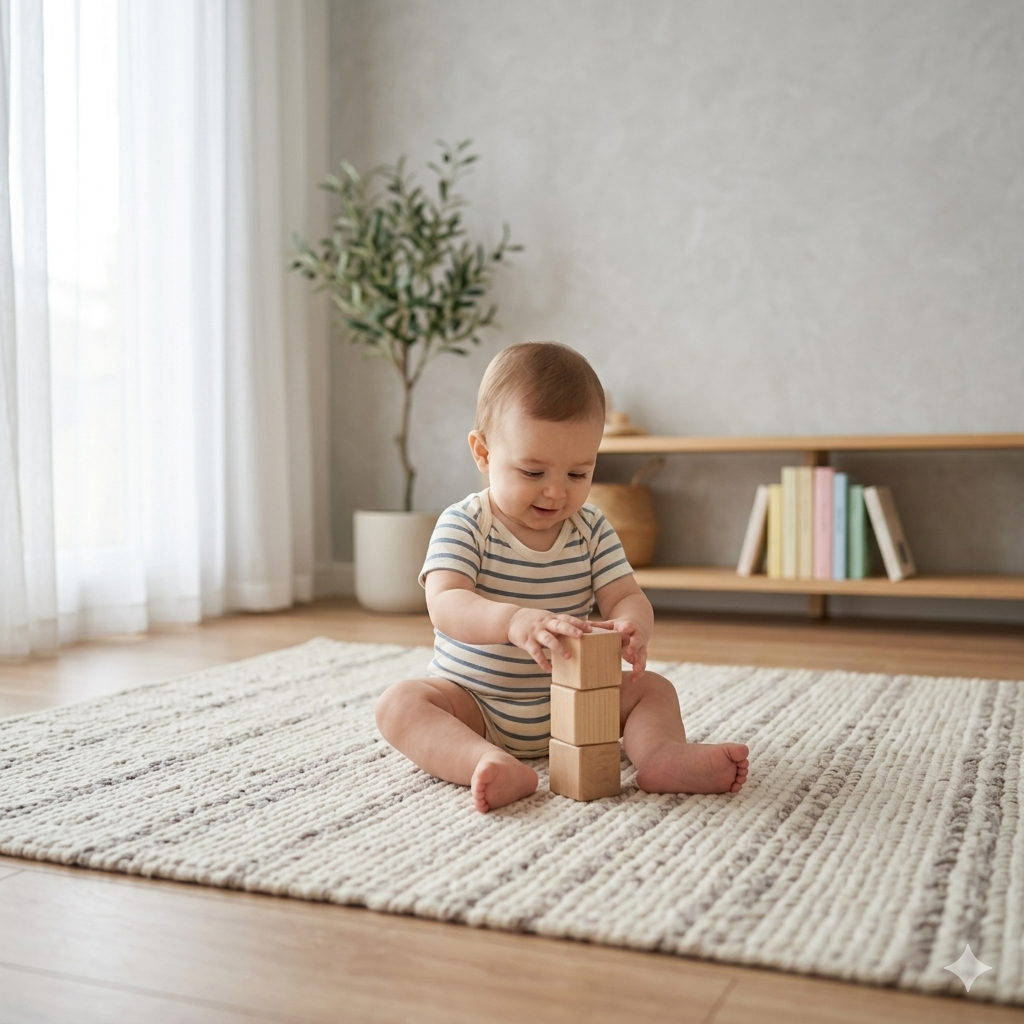
Free Movement: Letting Children Discover Their Own Abilities.
16 September 2024A child doesn't need to be taught how to walk. They simply need a safe environment and time.
This is, in essence, the heart of "free movement" (motricité libre), an approach to child development theorized by pediatrician Emmi Pikler in the mid-20th century. It is gaining popularity today, both within families and in childcare settings such as nurseries and childminders. But what exactly does it mean?
The art of not intervening (too early).
Free movement is based on a simple idea: a child develops better and gains greater self-confidence if they are left free to explore their environment at their own pace. Adult intervention is kept to a minimum: we do not place the child in a position they haven't mastered on their own yet.
♦ We don't sit them up if they don't know how to sit by themselves (usually from a tummy position).
♦ We don't stand them up if they don't have the strength to pull themselves up.
♦ We don't help them walk by holding their hands if they can't balance on their own.
Every stage reached by the child is a personal victory, the result of their own neurological and muscular maturation.
A crucial role for the adult.
While free movement might seem passive for the parent or caregiver, it is actually a posture of active observation. The adult creates the framework:
♦ Safety: The space must be completely secure (no sharp edges, fragile items, or accessible electrical wires).
♦ Setup: Provide a firm play mat, simple toys within reach, and as the child grows, small obstacles (like a cushion) to encourage them to pull themselves up.
♦ Encouragement: The adult’s reassuring presence, kind gaze, and encouraging words are the engine of the child’s exploration.
What are the benefits?
Observers of this method note several advantages:
♦ Self-confidence: The child takes pride in their successes, big or small.
♦ Safety and balance: A child who has learned to fall and get back up on their own is often more comfortable with their body and less prone to clumsy falls.
♦ Joy of discovery: They explore at their own pace, without pressure.
In conclusion, free movement is not a mandate to "do nothing." It is a shift in perspective that places the child at the center of their own development. Whether you are a parent or a professional, the most important thing is to find the balance that suits your child and your daily life.
 Back to news